 I visited today's Free Verse Poetry Book and Magazine Fair in London. Poetry book publishing still looks healthy. The books are well produced too.

 My story collection "By All Means" (ISBN 978-0-9570984-9-7), published by Nine Arches Press, is on sale from
Another Look at Odysseus #4
14 hours ago
I visited today's Free Verse Poetry Book and Magazine Fair in London. Poetry book publishing still looks healthy. The books are well produced too.
Let’s face it, short stories aren’t popular in the UK. In 2002 "fewer than 25 books of short stories were produced by mainstream publishers. And two thirds were by writers from abroad" (Debbie Taylor, Mslexia). Things have improved since then – mostly because of small presses. Even so, when a collection does well it’s because the author’s already famous - Jojo Moyes, Tom Hanks, etc.
Before you try to publish a story collection (or publish it yourself) it’s a good idea to get individual stories published (not least because publishers look in magazines for authors). There are several ways to find the right place for your stories -
Warning – for any decent magazine, acceptance rates are likely to be below 1%.
Last night via Zoom I attended the triple launch of books by Tom Sastry, James McDermott and Laurie Bolger. I've already read the Sastry and McDermott books. I've not read Laurie Bolger's book yet. Sastry is deadpan/gloomy and Bolger's anything but. I liked some of hers the most, so I'm looking forward to reading her. McDermott (who writes for Eastenders and the stage!) read mostly about his father's death during covid.
The readers inserted little extra words here and there, and often didn't respect the inter-word spaces of the text. Sometimes in a line with spaces they paused where there wasn't a space. This all makes sense to me - some layout features are for the eye only, and I can understand why there might be "stage" versions of "page" poems.
I stayed a week in Spain, mainly based in Sevilla, which I've not seen before. Beer's cheap, drivers are very well behaved, and OAPs get 50% discounts on many of the attractions. We walked over 15km/day, seeing most of the attractions and chancing upon other things - covered markets, the Hungarian pavilion of the Seville Expo '92, a multi-venue craft fair in courtyards/studios etc. We tried a tapas bar, a vegan restaurant, a roof-top bar, a Michelin-listed restaurant (I tried calamares) and the same "family restaurant" twice.
 We didn't hire bikes - cycling up to Toledo would have been a struggle. Once there, I saw chess sets, swords and marzipan. Jews, Muslims and Christians sometimes lived together, sometimes fought.
 In Cordoba, the Mezqita (Mosque) incorporates a 16th century cathedral. The river's wide enough to have had 4 watermills. A big Arabic waterwheel had been copied.
 Culture wars continue to this day. Here someone (a purist Italian maybe) has defaced a menu, crossing out the Hawaii option.
 In a church shop they were selling this nativity scene accessory - a version of the "Jesus saves" joke.
 The Alcázar was impressive. The peacocks performed for the tourists. The place appeared in Game of Thrones. We also went into the smaller but still impressive Casa de Pilatos - a private house
 The Arabs in Sevilla had a notable poet long ago.
 The later Cervantes' name and characters appear in several places
 This bookstall was part of the big flea market in Madrid.
 I hardly saw any charity shops. This, I think, is a charity bookshop.
 And here's an English language bookshop.
 Madrid has a cemetery of 5 million graves (we saw it from the train), and much else besides.


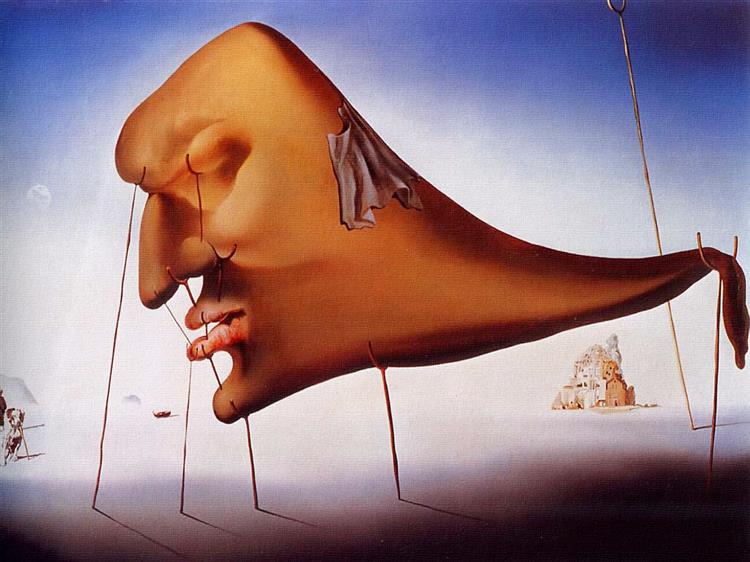 In painting, the "sleeping lover" is a genre, but that's not what Dali's depicting in "Sleep" - the head looks more like a dirigible that's lost all hope, precariously propped up. In paintings, closed eyes can mean death, but except for crucifixions statues of the dead are rare. I suppose using stone to represent death is too literal.

 Tonight, taking a detour around the scaffolding in the Great Court, Trinity, I passed the busy Servery to reach the Old Combination Room - a reading by Vona Groake (St Johns writer in residence), Karen Solie (Canadian) and some student poets. Tristram Saunders (Trinity poet in residence) was the compere. A free evening with free wine. About 20 attended, which included the performers. I've read and enjoyed books by the two main poets and liked a lot of the evening's poetry - "fog makes surprising what it does not conceal", etc.
 Last Sunday I attended an open-mic in a pub with Carrie Etter guesting. £5 and no free drink. About 40 attended. Maybe the publicity was better, or maybe the chance to read one's poems out is worth paying for. I didn't read but at least half the attendees did.
 My poetry pamphlet "Moving Parts" (ISBN 978-1-905939-59-6) is out now, on sale at the HappenStance site. For Reviews and Notes see the website


